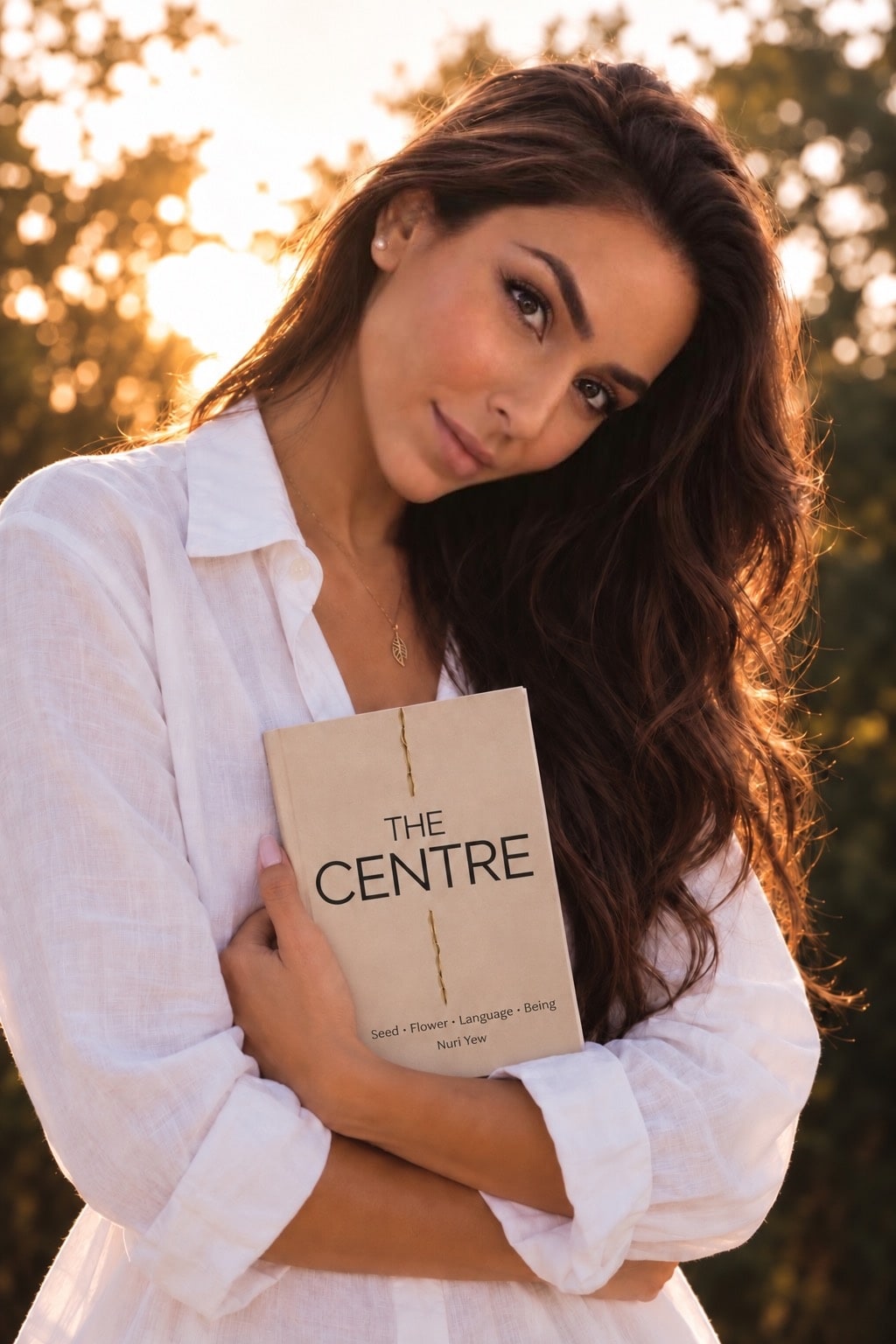
The Centre: A Language for Being

The Centre

Seed·Flower·Language·Being

What if you were never broken, only living a way of being the world never had the language to name?

The Centre is a poetic philosophy of recognition, language, and the inner structure of being.

Written in short verse and drawn from lived experience, it is a book about returning to what you felt before the world told you what it meant.

  • Not a book about fixing yourself.
  • A book about recognising what you are.
Buy the book

166 pages·five parts·short verse·read slowly·first edition 2026

The Centre by Nuri Yew, held against a sunlit stone wall
The reversal

You were never broken. You were unmet.

Where it matters most

One of the places this reversal matters most is in the way we understand pain.

We are quick to name what appears wrong.

Broken·Difficult·Too sensitive·Traumatised·Not enough

01Another history

A description of what we see is not always an explanation of what happened. Sometimes what looks like brokenness has another history.

  • Something wasn’t met.
  • Something wasn’t seen.
  • Something didn’t have language.
  • Something was named before it was understood.
02What was missing

Sometimes the wound is not only what happened. It is what was missing.

  • The glance that never came.
  • The steadiness that wasn’t there.
  • The part of you that nobody stayed long enough to understand.

Not only

“How do I fix myself?”

But

“What was actually happening here?”

How much of what we believe about ourselves began as language before we had the experience to know whether it was true?

A book to return to

This book was not written to be rushed.

Three movements

Read a page. Leave it. Come back.

A line you barely notice today may stop you six months from now.

The words haven’t changed. You have.

The Centre does not give you a programme to complete or a version of yourself you are expected to become.

It gives you language, questions and places to recognise yourself.

Some pages may meet something you have already understood. Others may sit quietly until life gives them meaning.

It is a book you return to.

Lines from the book

The writing, in its own language.

14 lines

“Language that arrives first invents you. Language that follows experience reveals you.”

“We are here to remember the ground.”

“They named the petals, not the root.”

“You were never broken. You were unmet.”

“Not everyone who loves you can choose you.”

“Pain is a miner. It digs up what was hidden.”

“Simplicity is what truth feels like when it is finally safe.”

“We have mistaken naming for knowing, and knowing for healing.”

“A Centre mirrored rightly, even once, never forgets its face.”

“Steadiness is not the absence of ache. It is the presence that can hold it.”

“Those who run out of air before the depth begins call the deep ones drowning.”

“Resilience is metabolising. Healing is being met. Survival is only the beginning.”

“A culture that praises performance calls landing a delay, and forgets that those who never land are the ones who crash.”

“People do not heal from being told the truth. They heal from recognising themselves in it.”

How the book moves

Five parts, from remembering to being.

I to V

I

Remembering

The recovery of an inner language. What was felt before it could be named.

II

The Silence

Pain, misnaming, unchosen-ness and what can happen when experience has nowhere accurate to land.

III

The Bloom

The emergence of the Centre and a language drawn from lived experience.

IV

The Living

Steadiness, recognition, resonance and what it means to live from Centre.

V

The Resolution

Unbroken being. What remains when we no longer begin from the assumption that we need to be fixed.

What lives inside it

The book gives language to experiences that are often felt before they are named.

A vocabulary of being

Not a dictionary·Not a set of diagnoses·A vocabulary of being

The Centre

The part of you that knows something before you can explain why.

The Delay

The space between experience and understanding.

Metabolising

The unseen process through which experience becomes something we can carry.

Recognition

Being met without distortion.

Resonance

Something true finding an answering presence.

Steadiness

The presence that can hold what is there.

Summit Words

The enormous words we use, love, healing, forgiveness, success, without always examining what holds them up.

Underwords

The ground beneath them. Safety. Care. Consistency. Truth.

Carriers

Those who hold what others may never notice needed holding.

Shield · Seed · Gift

What pain can become when it no longer has to remain only pain.

The words are not there to replace your experience. They are there to help you look more closely at it.

Explore the Lexicon

This isn’t a book about a certain kind of person.

It proposes a different order for understanding human experience.

Experience firstLanguage after

And it asks what might change, in ourselves, between each other, and in what we pass on, if we began that way.

The invitation

This book is not only about what hurt us. It is about how we come to know ourselves.

From childhood onwards, we inherit language for almost everything.

  • Love
  • Success
  • Healing
  • Strength
  • Normal
  • Enough
  • Too much
  • Broken
  • Lost
  • Unlovable
  • Misunderstood
  • Confused

Language helps us make sense of being human, but it also carries weight. A word can recognise an experience, and a word can obscure one. A word can bring us closer to ourselves, and a word can quietly become the lens through which we learn to see ourselves.

The Centre asks us to notice the difference.

What did I actually experience?

What did I feel before I explained it?

What have I accepted because there was already a word for it?

What do I know before I know how to say it?

This is not an argument against language. It is an argument for putting language back in its right place.

Experience first·Language after

And enough space between the two for meaning to become our own.

Because this reaches beyond the individual.

  • How we listen.
  • How we love.
  • How we understand one another.
  • How we speak to children.
  • How we respond to pain.
  • How we decide what another person’s experience means.
  • The Centre is not a destination for a particular kind of person.
  • It is an invitation to all of us to come back to ourselves.
The movement

What changes if we begin from within?

The book begins with one person. But it does not end there, because the language we use does not stay with us.

  • We give it to our children.
  • We carry it into relationships.
  • We use it to describe people we do not understand.
  • We build ideas of love, strength, success and healing from it.

And those meanings travel.

The Centre imagines another direction.

Not a world without language. A world in which language follows closely enough behind experience to tell the truth about it.

  • A life lived according to should.
  • A life lived from what I choose.

A child

learning to notice what happened inside before being required to explain why.

A person

learning that not knowing yet is not failure.

A relationship

in which listening comes before interpretation.

A culture

less interested in immediately naming what it sees, and more willing to understand what is actually there.

We are here to remember the ground.

In readers’ own words

What happens when the book meets someone else.

Verified reviews

★★★★★

“I’m glad I came across this book. I read it in one day. Deeply philosophical yet written with such tenderness and kindness.”

A one of a kind book

★★★★★

“There were moments where it felt like I was experiencing some of the things the book describes through reading the words.”

Uniquely relatable

★★★★★

“Written from the heart, it shows a real insight into the soul and the rawness of life, the joy, the pain, the loss and the discovery of the self.”

A joy to read

★★★★★

“Gives language to what can’t be easily expressed. At last, a communication from the heart directly to my heart and yours.”

Immersive read

“The poetry makes you want to keep reading, but the philosophy constantly makes you stop and think.”

The language continues

The book was the beginning.

A language grew from its pages.

  • The Centre
  • The Delay
  • Metabolising
  • Recognition
  • Resonance
  • Steadiness
  • Summit Words
  • Underwords
  • Carriers

The Lexicon of Being brings that language together and allows the ideas to continue beyond the book.

Explore the Lexicon
Where do you begin?

Five ways in.